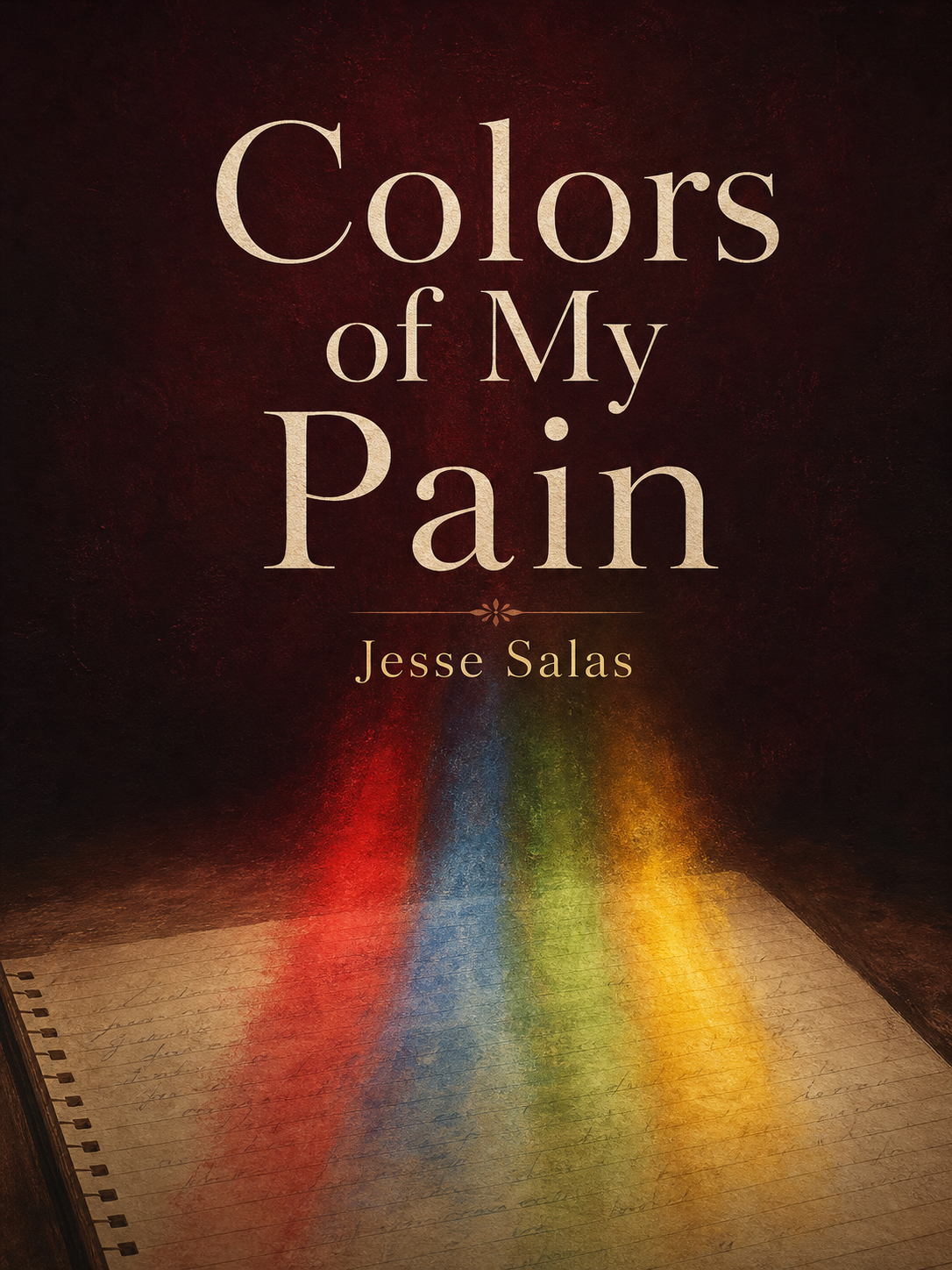
A Book by Jesse Salas

Colors of My Pain

Understanding Yourself, Your Wounds,
and the Way You Love
by Jesse Salas — Creator of the Four Colors Personality Framework

"Pain does not define who you are. Your understanding of that pain does."

— Jesse Salas
Take the Four Color Quiz Read More
▼ Scroll to explore
What This Book Is
Part memoir. Part framework. All real.

This is not a typical self-help book. It's a true story wrapped around a framework that took 30 years to build.

Colors of My Pain follows Jesse Salas from a silent, observant child — a "Candy Kid" who learned that being sweet was safer than being honest — through loss, incarceration, collapse, and rebuilding. Along the way, he discovered something that changed everything: the Four Colors.

Red. Blue. Green. Yellow. Four personality colors that explain why you love the way you do, why you hurt the way you do, and why the same moment can wound two people in completely different ways.

You are not broken. You adapted. And adaptation, once understood, can be changed.

The Four Colors
The framework at the heart of the book
🔴
Red — The Direct Leader
Driven by control, responsibility, and directness. Moves toward problems. Protects fiercely. Struggles when intensity is labeled aggression.
🔵
Blue — The Emotional Connector
Driven by connection and emotional presence. Feels deeply. Adapts fluidly. Struggles when feeling unseen or performing to maintain belonging.
🟢
Green — The Logical Thinker
Driven by logic, stability, and precision. Observes before acting. Struggles when calm is mistaken for indifference.
🟡
Yellow — The Compassionate Caregiver
Driven by harmony, care, and reassurance. Nurtures and supports. Struggles when generosity is taken for granted.
Discover Your Color → FourColorQuiz.com
From the Pages
Words that stay with you

"The Candy Kid is the child who learns early that being sweet is safer than being honest. They are the observers. The helpers. The ones who smile through confusion and step in before anyone asks."

Chapter 1 — What the Candy Kid Is

"Kindness becomes protection. Compliance becomes safety. Silence becomes strategy. No one teaches them this. They discover it through consequence."

Chapter 1

"When you can name something, you can work with it. When you can see a pattern clearly, you can choose to run it — or interrupt it. That interruption is the whole point."

Final Reflection

"Pain is inevitable. Suffering is optional. But confusion — confusion can be interrupted."

Opening
What's Inside
58 chapters across 4 parts — 15,500+ words

Table of Contents

Part One: The Candy Kid — How Sensitive Children Learn to Survive
1. What the Candy Kid Is
2. Watching Instead of Speaking
3. Learning to Please
4. When Being Good Is Safer Than Being Real
5. Emotional Hunger
6. The Cost of Niceness
7. Love That Feels Conditional
8. When the Candy Runs Out
Part Two: Colors of My Pain — What Happened When the Framework Had No Name
9. Before the Colors Had Names
10. The Day Everything Changed
11. December 22, 1994
15. The Gun, the Fight, and the Shot
16. The Courtroom and the Crossroads
20. Anger as Armor
25. The Day Everything Stopped
26. Incarceration and the Death of Illusion
28. Mercy That Made No Sense
30. Faith Without a Formula
...and 12 more chapters
Part Three: Understanding the Red in Me — Naming the Color That Almost Broke Me
31. Seeing the Colors Clearly
33. What Red Really Is — and What It Is Not
36. Why Red Gets Labeled the Villain
37. Anger Is a Signal, Not an Identity
41. The Death of Ego
46. Red as a Gift
47. Jealousy and the Four Colors
Part Four: Dating by Color — Why You Love the Way You Do
48. Why Dating Feels So Confusing
50. How Each Color Loves
51. Color Pairings — Where It Works and Where It Breaks
52. How Each Color Fights
53. What Each Color Needs When Hurt
55. The Nonchalant Partner — Calm or Cold?
57. Full Circle: A Daughter Found
58. Healing Before the Next Relationship
Who This Book Is For
If any of these feel familiar, this book was written for you
  • People who grew up learning that being "good" was safer than being real
  • Anyone who gives too much and can't figure out why they feel so empty
  • People whose anger scares them — or scares the people they love
  • Anyone trapped in the same relationship pattern over and over
  • Parents who want to understand their children before the damage is done
  • Anyone who has been told they're "too much" or "not enough"
  • People who feel broken but haven't found the language to explain why
  • Anyone who wants to understand — not just survive — their own pain
A Word to Each Color
From the final pages of the book

To the Red Reader

"Your intensity is not a flaw. Your directness is not cruelty. Your instinct to lead is not arrogance. But your quick pace can run ahead of your understanding. Pause long enough to translate what you are feeling before you act on it. True control begins inside."

To the Blue Reader

"Your emotions are not weakness. Your sensitivity is not a flaw. Your need for connection is not too much. But expression without grounding leaves you scattered. You are allowed to feel everything. You are not required to perform it."

To the Green Reader

"Your logic is not coldness. Your carefulness is not cowardice. But logic alone does not reach people. Thinking without connecting creates a kind of loneliness that analysis cannot solve. Let others in — even when it is imperfect and uncomfortable."

To the Yellow Reader

"Your care is strength, not foolishness. Your patience is resilience. But giving without boundaries is not generosity. It is slow self-erasure. Protect your energy. Your compassion is a resource, not an obligation."

About the Author
The man behind the framework

Jesse Salas is the creator of the Four Color Personality System — an original framework developed over thirty years of observing human behavior across relationships, families, workplaces, and communities.

His work spans photography, coaching, business development, and content creation. He runs multiple businesses from Olivehurst, California, and hosts the Quiet Authority channel focused on personality and human behavior.

Colors of My Pain is his most personal work — a memoir and framework woven together to give readers both the story and the tools. Because theory without proof helps no one, and proof without theory leaves people alone with their pain.

You Are Not Broken. You Adapted.

And adaptation, once understood, can be changed.

Take the Four Color Quiz Contact Jesse

Explore Jesse's Universe